RAG vs Memory: Understanding the Difference for Enterprise AI
Why Retrieval and Memory Are Different Systems and What the Confusion Costs the Enterprise.
The industry spent the last two years learning how to bolt knowledge onto a language model. The move almost everyone made was retrieval-augmented generation, or RAG, and somewhere along the way the field started calling it memory. It is not memory.
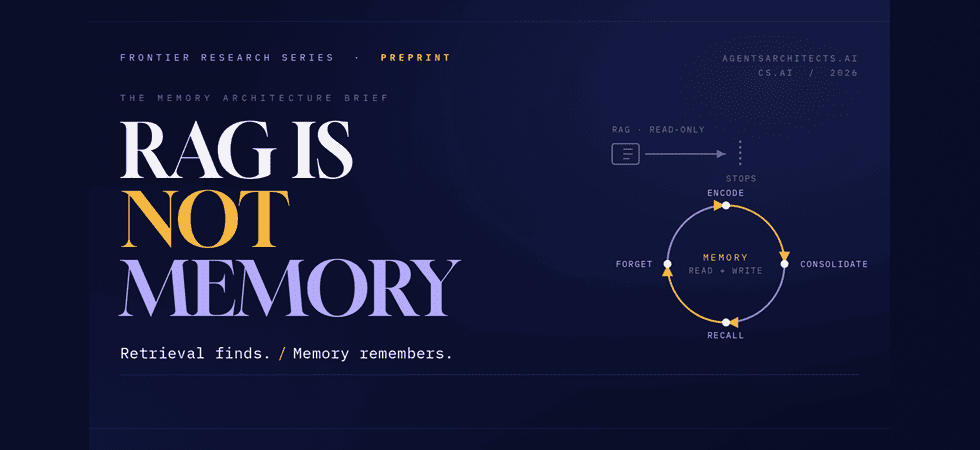
RAG is a read-time mechanism. It fetches passages from a fixed, externally curated corpus and drops them into the context window. Memory is something else: a stateful substrate that an agent writes to and reads from, holding what it learns about its own experience, its users, and a world that keeps changing. The two share one primitive, vector similarity search, which is exactly why they get confused, and exactly why the confusion is hard to spot until it has already cost you something.
A system built for retrieval can fetch a document. It cannot learn from an interaction, personalize, resolve a contradiction, or reason about time. For a Chief AI Officer the takeaway is blunt. If your agents “remember” by searching their own old messages, they will keep forgetting the things that matter, and at enterprise scale that forgetting stops being a quality problem and becomes a governance, cost, and security one. For a researcher, retrieval that is genuinely native to memory, meaning bounded, temporal, attenuable, and auditable, is still largely unbuilt, and that is where real progress can be made.
The thesis is not that RAG is dead. It is narrower and more useful than that. Naive RAG is the wrong abstraction for memory, and treating retrieval as memory is an architectural mistake that compounds with scale and autonomy.
1. Why Retrieval Keeps Getting Mistaken for Memory
Agent architectures have moved out of the demo and into production. The moment an agent has to run for more than one turn, somebody asks for memory, and the default answer is RAG. The reasoning is seductive. Embed the agent’s old messages, retrieve the ones most similar to the current turn, and you have given it a kind of memory. It works often enough to look right, and fails often enough to be dangerous.
The trouble is that the two constructs are wired from the same part. Both RAG and memory call a vector index under the hood, and both inject external context into a prompt, so from the outside the mechanics look interchangeable. They are not. RAG answers one question: what does this corpus say about the query? Memory answers a different one: what do I know about this user, this task, and this world, and how has that knowledge changed? A system tuned for the first cannot, by construction, answer the second.
That second question is the one that bites in production. An agent that talks to the same users across sessions, that pursues a goal over many steps, that is handed “manage my expenses” and expected to act, needs continuity. Continuity is a memory property, not a retrieval one. The practitioner community has already named the symptom. Using RAG as a memory substitute is a common reason agents keep losing context they were given only a few turns earlier. So the thing to study is not the retriever. It is the memory the retriever is being asked to impersonate.
2. The Category Error, Restated
The distinction is precise enough to write down.
What RAG is. Given a query, RAG runs three things: an encoder that maps text to a vector, a retriever that returns the most similar passages from a pre-built index over a fixed corpus of documents, and a generator that produces the answer from the query and those passages. Three properties follow. The corpus is fixed at inference time. It is built offline, and the act of answering never touches it, so RAG reads but never writes. Relevance is governed by embedding distance and nothing else. And the operation is memoryless across queries: each query is independent, and RAG retains nothing about earlier interactions unless that history is itself re-embedded into the same corpus, which only moves the problem somewhere else.
What memory is. Memory is the layer that decides what to keep, turns it into a durable representation, maintains it as reality changes, and recalls it selectively to shape what the agent does next. It is stateful, and it can write. Over a stream of interactions it supports at least five operations. It encodes, distilling salient facts from raw interaction rather than storing the logs. It stores them against an identity. It consolidates, merging overlapping entries, overwriting stale ones, and resolving contradictions. It retrieves, scoring candidates by similarity, recency, and importance together. And it forgets, decaying or evicting low-value entries to stay bounded.
The error, in one sentence. RAG is a retrieval technique. Memory is an intelligence layer that uses retrieval as one of its operations. To call RAG memory is to mistake a component for the system that contains it. RAG answers “what does the document say?” Memory answers “what does this user need?”, and that information very often lives in no document at all.
This is not a quirk of language-model engineering. It mirrors a settled structure in the study of human memory, where retrieval has never been the whole of memory, only one phase of it. The classic multi-store view separates a small working store from a vast long-term one, with transfer between them driven by active processes rather than passive proximity. Long-term memory itself splits into episodic memory (time-stamped records of what happened and when), semantic memory (distilled, context-free facts), and procedural memory (how to do things). RAG exposes a single flat operation, similarity search over an undifferentiated corpus, which maps at best onto a fragment of semantic memory, and even there it skips the consolidation that turns experience into knowledge. Treating it as memory does not just leave gaps. It collapses four distinct systems into one.
3. Anatomy of a Recall: What Crosses Into the Context Window
To see where the impersonation breaks, follow what physically crosses into the prompt when an agent “remembers.”
In a RAG pipeline, documents are chunked, embedded, and indexed offline. At query time the user’s text is embedded, the retriever pulls the nearest chunks, and a context injector concatenates them ahead of the generator. Every step in that pipeline is a read. There is no path by which answering a query modifies the index. Structurally, it is a search engine bolted to a generator.
A memory system contains that read path but adds the parts that make it stateful. An extraction layer parses the interaction and pulls out facts worth keeping. A write path, the one component absent from every RAG pipeline, adds, updates, or deprecates entries. A consolidation step compares each new write against what is already stored and decides whether to add, update, delete, or do nothing. A scoring function ranks candidates by a blend of similarity, recency, and importance. A retrieval layer reads selectively from the store, and an eviction policy prunes it to keep it bounded.
This gives a simple way to think about it. RAG is the read path of a memory system. It is necessary, but it is not sufficient. Strip extraction, the write path, consolidation, and eviction away from a memory system, and what remains is RAG. That is why RAG-as-memory feels almost right and behaves almost wrong, and the gap between almost-right and right is the whole failure surface.
There is a subtler mismatch even inside the read path. RAG was designed for large, heterogeneous corpora, where retrieved passages are diverse and the main failure is irrelevance. Agent memory is the opposite: a bounded, coherent interaction stream full of correlated, often duplicate spans. Drop fixed top-k similarity into that setting and it returns redundant context and can discard the temporally linked facts a correct answer depends on. So even the retrieval primitive needs rethinking when the source is memory rather than a pile of documents.
4. Four Things Retrieval Cannot Do, and How They Compound
The breakages above produce a familiar set of failure modes. They are bad on their own. Together they are worse, because each one removes a defense that the next one needs.
4.1 No write path, so nothing is ever learned
Because RAG cannot write, the world can change but the index cannot. A long-lived agent acts with confidence on facts that were true at indexing time and are false now, and nothing in the interaction that revealed the change feeds back to correct the store. Staleness here is not a tuning problem. It is structural. An index built offline has no way to learn that the customer moved, the policy changed, or the user just told you something new.
4.2 No consolidation, so contradictions pile up and reinforce
With no consolidation step, old and new entries sit together with no sense of which one supersedes the other, and contradictory facts get retrieved side by side. It gets worse than that. When a retrieval-only system treats a stored item as ground truth and that item is wrong, nothing challenges it. The bad memory quietly shapes every decision downstream, and the system keeps confirming its own mistake. Consolidation is the step that would have caught it, and RAG has no such step.
4.3 Similarity-only ranking, so importance is invisible
RAG ranks by embedding distance alone, so it has no way to know that some facts matter more than others. Scored on similarity, a system will cheerfully surface “likes jazz” over “allergic to peanuts” because the trivial fact happens to sit closer to the current query. The importance weighting that a memory system folds into its scoring exists precisely to stop this, and retrieval has no equivalent.
4.4 No identity scope, so personalization and governance both fail
This is the failure with the longest reach. RAG searches a shared corpus with no native idea of whose information it is, so it can neither personalize nor govern. The personalization failure is easy to picture. A user says “today is my birthday.” The system embeds “birthday” and searches for similar past messages, and the facts that would actually personalize the reply, a favorite color, a past party theme, never come back, because they are not close to “birthday” in embedding space. A friend with a working memory connects them without thinking. Similarity search cannot. The governance failure is the same gap wearing a suit. If the system cannot say whose memory this is, it cannot enforce who is allowed to recall it.
How they compound. None of these is fixable with a bigger k or a better embedding model, and each one makes the others worse. No write path means stale facts. No consolidation means the stale facts are never reconciled. Similarity-only ranking means the wrong facts surface first. No identity scope means all of it happens across boundaries nobody ever drew. Every missing operation removes the defense that would have contained the next one’s damage.
5. Why the RAG Stack Cannot Carry Memory
It is tempting to think that better retrieval closes the gap: smarter chunking, hybrid search, a re-ranker, a larger context window. It does not, and the reason is structural rather than a matter of effort.
The RAG stack rests on assumptions that memory breaks. It assumes the knowledge lives in documents, but memory’s content is distilled from interaction and lives in no document. It assumes the corpus is curated and stable, but memory’s content is generated continuously and has to change. It assumes relevance is similarity, but memory’s relevance is similarity weighted by recency and importance. And it assumes each query stands alone, when memory exists precisely to carry state from one interaction to the next. You can tune retrieval all the way to its ceiling and still have no write path, no consolidation, no importance signal, and no identity scope, because none of those are retrieval problems.
The field’s real position is not that RAG is dead. RAG is still the right architecture for breadth, reaching across millions of heterogeneous documents to surface what a query needs without retraining a model. That is genuinely useful, and it is not going anywhere. The accurate claim is narrower. Naive RAG is the wrong tool for agent memory. The moment the job is continuity rather than lookup, the stack runs out, and no amount of retrieval tuning extends it.
6. What Memory Must Mean at an Agent Boundary
If we are going to keep using the word memory, it has to mean more than “the agent retrieved one of its old messages.” A system earns the word only if it can do all of the following, and do them continuously rather than once at setup.
- A write path. The system can create, update, and deprecate stored knowledge as a result of interaction. This is the sharpest line between retrieval and memory, and everything else depends on it.
- Extraction, not logging. What gets stored is distilled facts, preferences, and events, not raw transcripts. Memory is curated state, not a bucket of history re-embedded for search.
- Consolidation and conflict resolution. On every write, the system reconciles new information against old. It merges the overlapping, overwrites the outdated, resolves the contradictory, and keeps a single source of truth.
- Importance-aware retrieval. Recall is scored by a blend of similarity, recency, and importance, so a safety-critical fact is not buried under a more similar but trivial one.
- Temporal awareness. The system tracks recency and supersession, so that as facts accumulate and change, the freshest truth surfaces and the stale one is updated or dropped.
- Identity scope. Memory is partitioned by user, agent, and organization, so recall is bounded to whom the knowledge belongs and governance can be enforced at that boundary.
- Bounded forgetting and auditability. The store stays bounded through deliberate eviction, and every write, update, and recall is traceable to its origin, so the memory can survive a review and not merely answer a query.
Most production systems satisfy one or two of these, usually retrieval and, if you are lucky, a write path. Almost none satisfy all seven. That gap is the difference between a search engine and a memory.
7. Candidate Building Blocks, and Where Each Stops
There is real work here, and it is moving fast. A senior practitioner should know what each block gives and where it runs out.
Tiered context management, the MemGPT pattern. It treats the context window like RAM and an external store like disk, paging information in and out so the agent manages its own working set. This is the cleanest answer to the finite-context problem, and the origin of the operating-system framing for memory. Where it stops: paging solves what fits in context, not what is worth keeping, and the harder consolidation and importance questions sit a layer above it.
Dedicated memory layers, such as Mem0 and A-Mem. These add the missing operations directly: extraction, conflict-resolving writes, and scoring that blends similarity with recency and importance. This is the closest thing to memory-as-a-system you can take off the shelf, and the right default when personalization across sessions matters. Where it stops: the field is young, its guarantees are empirical rather than formal, and identity scoping and governance are mostly left to the integrator.
Graph and temporal-knowledge-graph memory. These retrieve facts through entities and relationships rather than raw similarity, which is what makes multi-hop and temporal reasoning tractable, the very queries pure vector recall handles worst. Where it stops: building and maintaining the graph is real engineering, and the production patterns are only now stabilizing.
Hierarchical and structured memory retrieval. This accepts that agent memory is a bounded, correlated stream and organizes it, from episodic to semantic and from detail to theme, so retrieval runs over structure instead of flat top-k. It is the most direct fix for the redundancy and lost-prerequisite problem inside the read path. Where it stops: the structuring step itself is unsettled, and there is no agreed standard for how the hierarchy gets built or searched.
No single block closes the requirements list in Section 6. For now, the answer is to compose them rather than wait for one framework to do everything.
8. A Reference Memory Architecture
This is where I move from interpretation to a position of my own. The architecture I argue for treats memory the way the Agentic Authority Architecture treats authority: as something owned by an identity, scoped, and governed at the boundary, not as a shared pool that everyone reads from.
Separate the four stores. Do not flatten them. Working context, episodic memory, semantic memory, and procedural memory have different contents, lifetimes, and access patterns. Collapsing them into one similarity index is the original sin of RAG-as-memory. Keep the active window small, keep episodes time-stamped, distill episodes into semantic facts through an explicit consolidation step, and let reusable routines accumulate as procedural memory.
Make the write path a first-class, governed event. Every memory write runs through extraction and a conflict resolver that decides to add, update, delete, or do nothing, and every one of those decisions is logged. Memory that changes silently cannot be audited. Memory that changes as a recorded event can.
Scope every memory to an identity. Take the four-tier model, organization then user then agent then capability, and attach it to memory, not only to actions. Recall is then bounded by whose knowledge it is, and the question of who is allowed to remember what becomes an enforceable property rather than an open one. Adding a memory layer on top of an ungoverned shared corpus does not fix this. It makes it worse, because the system is now learning, permanently, across boundaries nobody ever drew.
Retrieve by similarity, recency, and importance, never by similarity alone. The scoring function is where safety-critical facts are kept from being buried, so it is not a tuning detail. It is a control.
Forget on purpose. Bounded eviction is a feature. An agent that never forgets accumulates stale, contradictory, low-value state until recall degrades and cost climbs. Decide what decays, and make the policy explicit.
The shape of it is this. Keep the stores distinct. Make the boundary where memory is written and read the place where you enforce governance. Weight recall by importance rather than mere closeness. And treat forgetting as designed behavior, not an accident.
9. What Enterprises Should Do in the Next Two Quarters
For a CAIO who wants an action list rather than an architecture diagram, here is where to start.
- Find every place you are using RAG as memory. Any agent that “remembers” by searching its own past messages is a candidate. You cannot fix continuity you have not located.
- Decide, per use case, whether you need breadth or continuity. Document Q&A and broad lookup stay on RAG. Same-user, multi-session, personalized, or fact-changing workloads need a memory layer. Most real agents need both.
- Add a write path before you add more retrieval. If your system cannot update or deprecate what it knows, no embedding upgrade will stop it from acting on stale facts.
- Scope memory to identities. Partition by user, agent, and organization now, so that personalization and governance are properties of the store rather than afterthoughts.
- Score recall by importance, not just similarity. Make sure the fact that matters most is not the one that ranks lowest because it was worded differently.
- Budget memory as a bounded cost. Re-stuffing full history into every prompt grows token cost without limit. A bounded store plus retrieval turns that into a fixed, governable line item.
- Audit what your agents remember. Require that every stored fact can be traced to the interaction that produced it, and every overwrite explained. Memory you cannot audit is a liability waiting for a review.
None of this waits on the frameworks to settle. It waits on you to stop treating retrieval as memory and start treating memory as its own layer: written, scoped, scored, and deliberately forgotten.
10. Open Problems for Researchers
For the PhD students and fellow researchers reading, the most consequential problems here are unsolved and well posed.
- Retrieval native to memory. Top-k similarity is a RAG inheritance, ill-suited to bounded, correlated interaction streams. What retrieval operators, whether hierarchical, structural, or component-decoupled, are native to memory rather than borrowed from corpus search, and how do they trade recall against redundancy?
- Consolidation as a learning schedule. When should an episodic record be promoted to semantic memory, and how do we keep that promotion from over-generalizing on unrepresentative episodes? Can complementary-learning-systems theory be turned into a concrete, testable consolidation policy for agents?
- Principled forgetting. Forgetting is a feature, but the policies are heuristic. What decay and eviction rules provably bound cost and stale-fact risk while preserving the facts that still matter?
- Calibrated conflict resolution. The decision to add, update, or delete on a contradicting write is currently a heuristic call. Can it be made calibrated, uncertainty-aware, and auditable?
- Governance-native memory. How do identity scoping and access control become first-class properties of the memory substrate rather than a wrapper bolted around it?
- Evaluation that measures memory. Existing benchmarks such as LoCoMo, LongMemEval, and PerLTQA are conversational and largely single-user. What does trajectory-level, multi-agent, governance-sensitive memory evaluation look like for the enterprise? And a standing warning for practitioners: never validate a memory system with a RAG benchmark, because relevance@k tells you nothing about whether the agent will correctly remember, six sessions later, that a fact it stored has since been overwritten.
Conclusion
RAG and memory rest on the same primitive and answer different questions, and the cost of confusing them is not theoretical. It shows up as agents that forget their users, act on stale facts, surface trivia over safety-critical information, and quietly reinforce their own errors. Each of those defects traces back to an operation that memory performs and retrieval, by definition, does not. At enterprise scale the stakes only rise, because memory is where governance, auditability, cost control, and a new write-path attack surface all live.
The fix is not a better retriever. It is to treat memory as its own architectural layer, with four stores kept distinct, a governed write path, identity scope, importance-weighted recall, and forgetting by design, and to deploy RAG where it genuinely excels, as the read path for breadth.
The sentence to retire is “RAG gives my agent memory.” The one to keep is shorter. Retrieval finds; memory remembers. The difference is a write path, a lifecycle, and a reason to forget, and your agents will show you, a few sessions in, whether they have any of the three.
Frontier Research Series. Produced with the AuthClaw Foundation and the AGI Learning Hub, India.
Further reading
Lewis et al., Retrieval-Augmented Generation for Knowledge-Intensive NLP Tasks (2020); Packer et al., MemGPT: Towards LLMs as Operating Systems (2023); Park et al., Generative Agents (2023); Gao et al., Retrieval-Augmented Generation for LLMs: A Survey (2023); Xu et al., A-Mem: Agentic Memory for LLM Agents (2025); Mem0: Building Production-Ready AI Agents with Scalable Long-Term Memory (2025); Atkinson and Shiffrin (1968), Tulving (1972), and McClelland, McNaughton and O’Reilly (1995) on human memory; benchmarks LoCoMo, LongMemEval, and PerLTQA.