PHP to Python Migration: Security, AI Tools & Modernization Guide (2026)
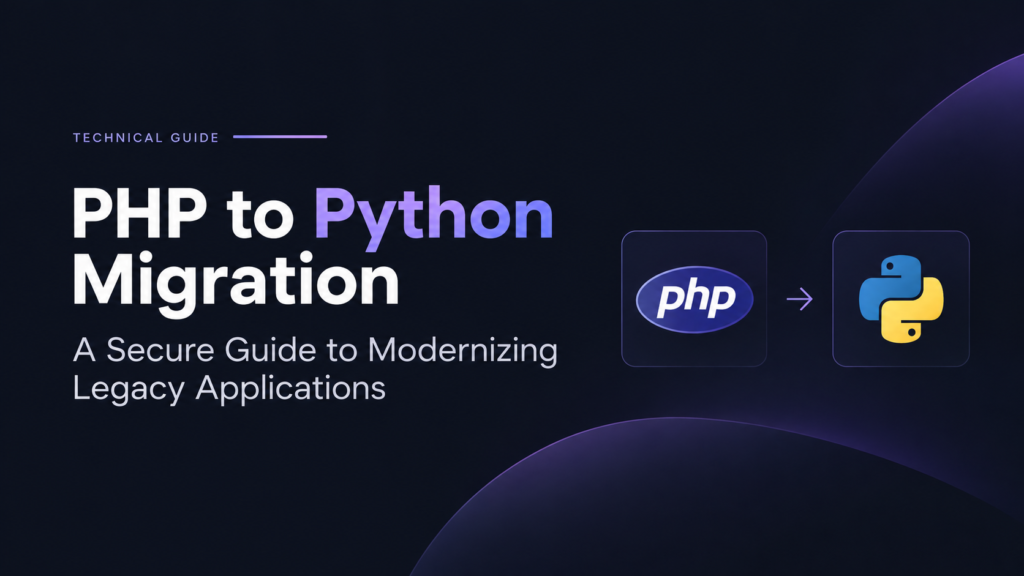
PHP to Python Migration After the October 2026 Vulnerabilities: A Secure Modernization Guide
For businesses running legacy PHP applications, the October 2026 security advisories raise two immediate questions: Is our application protected, and should we modernize it?
Start by addressing the security updates. Then assess whether upgrading your existing PHP application, replacing selected components, or migrating to Python offers the strongest long-term outcome.
PHP-to-Python migration can improve maintainability and support new capabilities, but changing languages alone does not make an application secure. The value comes from correcting weaknesses in architecture, permissions, dependencies, testing, and deployment.
What the October PHP vulnerabilities mean for your business
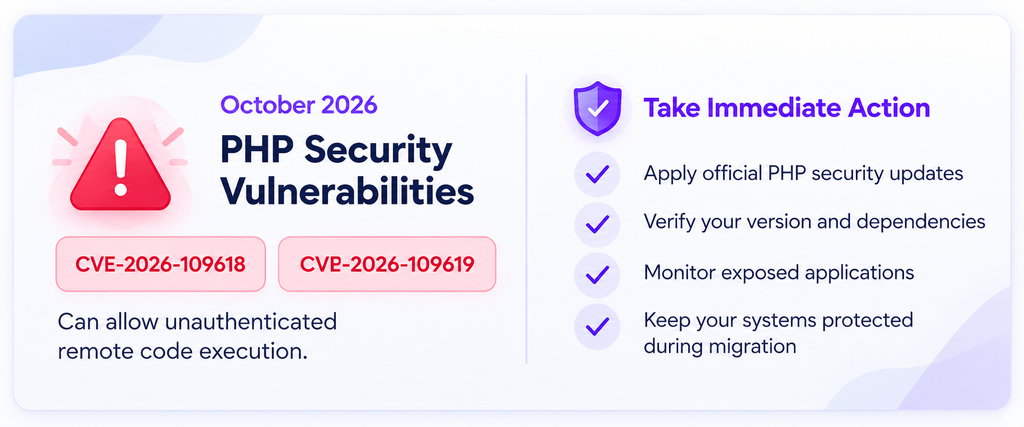
PHP’s 21 October advisory identifies two critical vulnerabilities, CVE-2026-109618 and CVE-2026-109619, that can allow unauthenticated remote code execution.
The project released fixes in PHP 8.5.12, 8.4.27, 8.3.36, and 8.2.35. Organizations should verify the appropriate update for their branch or vendor package using the official PHP advisory.
A modernization project must not delay immediate remediation. The application serving your customers today needs protection throughout the migration.
When should you consider PHP application modernization?
A well-maintained PHP application may need an upgrade rather than a rewrite.
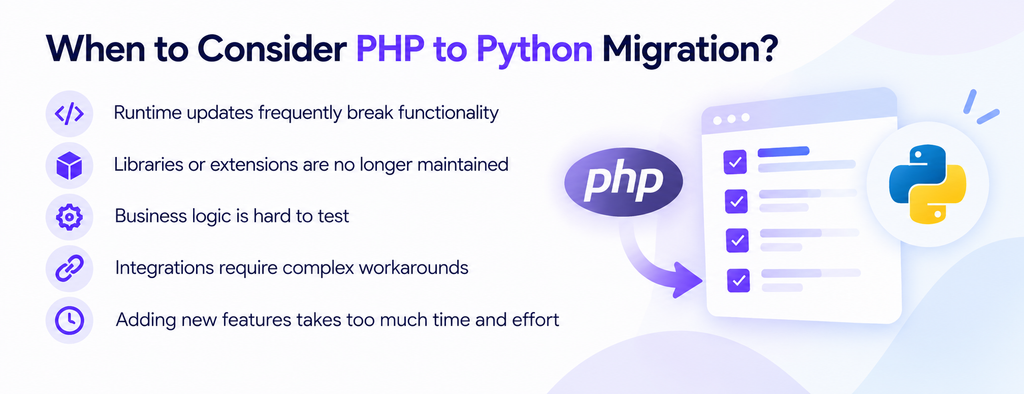
A broader modernization assessment becomes useful when:
- Runtime updates regularly break important functionality.
- Essential libraries or extensions are no longer maintained.
- Business rules are undocumented or difficult to test.
- Permissions behave differently across modules.
- Integrations require fragile workarounds.
- Releases depend on manual changes that are difficult to reproduce.
- Adding new capabilities takes disproportionate time and effort.
For example, a customer portal may still perform its original function while becoming increasingly difficult to integrate with identity providers, analytics services, or AI workflows. The assessment should identify which components create those constraints before recommending a replacement.
Is Python more secure than PHP?
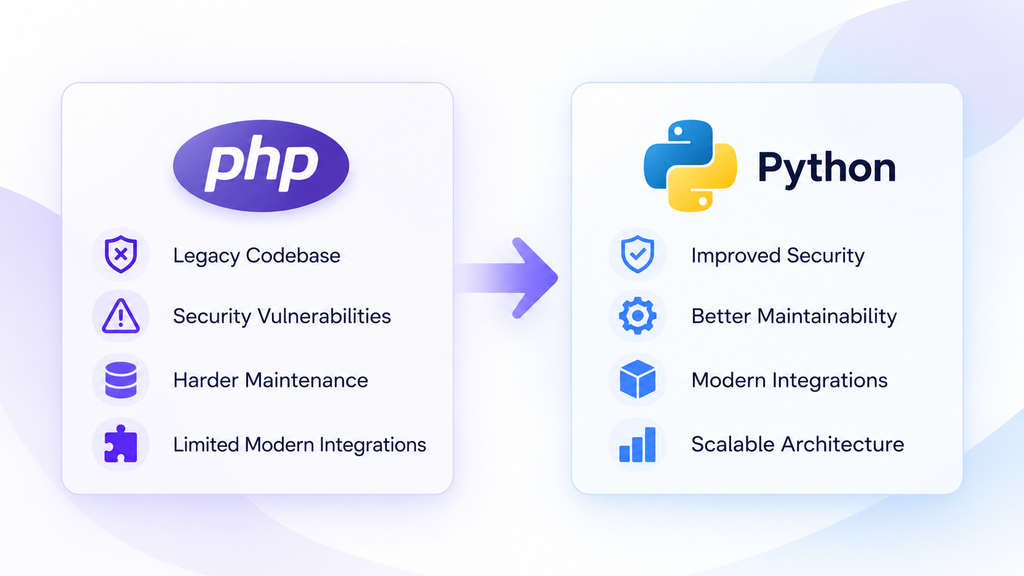
There is no blanket security guarantee from choosing Python over PHP.
A Python application can still contain broken access controls, insecure queries, exposed credentials, and vulnerable dependencies.
A migration should therefore define specific improvements:
- Consistent authentication and session handling.
- Permission checks for every sensitive action.
- Restricted access to customer and business data.
- Maintained dependencies with clear update ownership.
- Controlled secret storage and credential access.
- Security testing built into the release process.
Python may be an appropriate target when it fits your team, integrations, and application requirements. The decision should also consider whether improving the existing PHP system would achieve the same goals with less disruption.
Can AI automatically convert a PHP application to Python?
AI can assist with code analysis, documentation, translation, and test generation. These capabilities can help engineers work through unfamiliar legacy systems.
However, source-code translation addresses only part of a migration.
An existing application may depend on undocumented billing rules, customer-specific permissions, scheduled tasks, session behavior, or third-party integration assumptions. A generated replacement can appear correct while changing one of these behaviors.
As an AI researcher, I recommend evaluating AI-assisted modernization by the evidence it produces: which workflows are understood, which behaviors are tested, and which security boundaries have been verified.
Every generated change should remain subject to engineering review and business acceptance.
A practical PHP-to-Python migration process
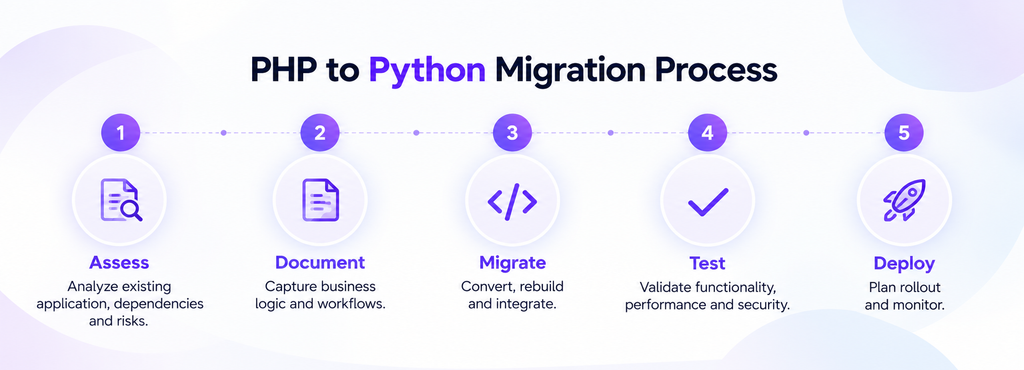
1. Assess the existing application
Inventory the runtime, dependencies, integrations, data stores, and deployment environments. Identify sensitive workflows and the people who can confirm their expected behavior.
The output should include prioritized risks, upgrade blockers, and a comparison of modernization options.
2. Document the behavior that must remain
Capture business rules before replacing implementation.
Test examples should include successful transactions, rejected actions, unusual inputs, and recovery from failures. For applications serving multiple customers, verify that one customer cannot access another customer’s records.
3. Design the target architecture
Choose frameworks and infrastructure according to the application’s needs. Define identity handling, permissions, data ownership, logging, and deployment controls before translating modules.
Avoid carrying unnecessary complexity into the replacement.
4. Migrate a bounded component first
Where practical, start with a component that has clear inputs, outputs, and dependencies.
Plan how the old and new systems will communicate, maintain consistent data, and handle failures. Establish rollback criteria before introducing production traffic.
5. Validate functionality and security
Compare the replacement against agreed acceptance criteria. Test integrations, transaction integrity, authorization, performance, and recovery.
A successful demonstration is useful, but production readiness requires evidence across the workflows that matter to the business.
6. Establish ongoing maintenance
Assign responsibility for updates, vulnerability response, monitoring, access reviews, and future changes.
Modernization delivers lasting value when the resulting application is easier to operate and maintain.
How much does PHP-to-Python migration cost?
A credible estimate requires more than a count of PHP files.
The main cost drivers include:
- Complexity of business rules.
- Number and condition of integrations.
- Existing automated test coverage.
- Data migration and reconciliation requirements.
- Availability and performance expectations.
- Security requirements and deployment constraints.
A focused assessment can separate essential work from optional improvements and produce a phased estimate. It may also reveal that a targeted refactor is more economical than a complete migration.
Frequently asked questions
Can we keep our existing database?
Possibly. The team must assess schema compatibility, queries, transaction behavior, and application assumptions. Keeping the database can reduce scope, but it does not remove the need for validation.
Can migration happen without stopping the business?
A phased approach can reduce disruption. Actual downtime requirements depend on data changes, integrations, and cutover design; they should be established during planning.
Should we migrate the entire application at once?
Not necessarily. Selective replacement can allow the business to validate the approach before committing to a larger transition.
What should we prepare for a modernization assessment?
Prepare an overview of your application, current technology stack, critical workflows, integrations, known issues, and business objectives. Source-code access can follow through an agreed secure process.
Build a modernization plan around your business
At AgentsArchitects.ai, we help businesses evaluate legacy applications and plan AI-assisted modernization with engineering review and measurable acceptance criteria.
A PHP Security & Modernization Assessment can establish your current risks, compare upgrade and migration options, and define a phased implementation roadmap.
If you are considering PHP-to-Python migration, contact AgentsArchitects.ai to discuss your application and the outcomes you need.