Google’s Teamwork Framework: How Multi-Agent Orchestration Expands AI Research Capability
Evaluating an AI research system requires examining the model together with its search procedure, tools, memory, verification mechanisms, and computational budget. Google’s Teamwork provides a timely case for studying this system-level perspective. This article examines the reported evidence, distinguishes mathematical reproduction from discovery, and develops an analytical framework for understanding when orchestration can improve research performance. It then proposes an implementation-independent architecture for evidence management, dependency-aware execution, adversarial evaluation, and enterprise governance. The mathematical models and experimental designs below are explanatory proposals, not Google’s disclosed implementation or new empirical findings.
1. What did Google actually report about Gemini Flash and Teamwork?
Google’s 27 August 2026 technical post reports that Gemini 3.7 Flash reproduced three mathematical results obtained with Gemini 3.1 Pro: subspace-approximation coresets, maximum-inner-product embeddings, and Hadamard quantization. The reported 71% TCSBench score used Flash with Pro. Lean verification concerned a separate Knuth’s Cycles result; it should not be attributed to all three Flash reproductions. Some research runs used increased parallelism.
This is an interesting capability demonstration. Its strongest defensible interpretation is that a model’s attainable performance depends partly on the environment in which it reasons. It does not establish that model capability is irrelevant, that orchestration always improves performance, or that a cheaper model necessarily produces a cheaper completed research result.
The term small model also needs care. Flash is a product tier; the sources cited here do not establish its parameter count. “Flash-tier model” is more precise than asserting a particular model size or comparing undisclosed parameter counts.
Likewise, “independently reproduced” requires an experimental definition. Was the original proof withheld? Were intermediate lemmas available? Did the run inherit a knowledge directory? Who selected promising attempts? A reproduction claim and a claim of independence from all solution information are different propositions.
Throughout this article, reported result means a finding attributed to its source. Analysis means an interpretation developed here. Proposed design means a suggested implementation or experiment. No independent reproduction of Google’s runs is claimed.
2. What is the Teamwork multi-agent framework?
Google describes Teamwork as an Antigravity orchestration framework in which agents generate, challenge, and improve candidate solutions. Its Long Proof pattern uses competing strategies, falsifiers, dependency-aware subproblems, synthesis tournaments, and retained failure knowledge. Patterns specify collaboration separately from orchestration code, and team composition can change during execution.
The operational documentation identifies a Sentinel coordinator, a project orchestrator, read-only explorers, implementation workers, and separate critic, challenger, auditor, and final-auditor functions. Work begins with an agreed brief and acceptance criteria. Structured artifacts carry project state, and file ownership separates concurrent edits.
These descriptions suggest an architectural question: what information and authority must cross each boundary for collaboration to remain useful?
A worker can produce an implementation without being authorized to declare the project complete. A critic can find a defect without knowing the best repair. A scheduler can allocate work without being a reliable mathematical verifier. These functions have different inputs, failure modes, and acceptance conditions.
For researchers, the unit of analysis should therefore include both the individual agent and the collaboration protocol. For enterprise CAIOs, procurement and deployment decisions should examine the entire execution system, including verification and recovery costs.
3. The three mathematical areas: what makes the tasks technically substantial?
3.1 Strong coresets for subspace approximation
For a matrix (A\in\mathbb{R}^{n\times d}), a strong coreset samples and rescales rows so that subspace costs are preserved simultaneously across a family of candidate subspaces. If (P_F) projects onto a subspace (F) of dimension at most (k), the target is
[ |SA(I-P_F)|{p,2}^{p} \in (1\pm\varepsilon)|A(I-P_F)|{p,2}^{p}. ]
Here, (|B|_{p,2}^{p}) sums the (p)-th powers of the Euclidean norms of the rows of (B). The same sample must satisfy the guarantee for every admissible (F).
Lin, Mirrokni, and Woodruff report a (\widetilde{O}_p(k^{p/2}\varepsilon^{-2})) coreset-size bound for (p>2), improving the earlier (\varepsilon^{-p}) dependence. The notation suppresses logarithmic factors and permits dependence on fixed (p). The paper also studies (1\le p<2); that broader paper scope should not be conflated with the specific reproduction described in Google’s announcement.
An instructional exercise is to ask students to identify every quantifier before attempting the proof. Preserving one chosen subspace is a weaker task than obtaining simultaneous preservation. An agent that silently exchanges these objectives can write a coherent argument for the wrong theorem.
3.2 Dimension lower bounds for maximum-inner-product embeddings
Jayaram and coauthors study the dimension required for a single-vector representation to approximate similarities involving multi-vector representations. For a singleton query, the relevant operation is a maximum inner product over a document’s vectors.
Their reported lower bound has the form
[ D\ge m^{c_\delta/\varepsilon^{2-2\delta}}, ]
for fixed (\delta\in(0,1)), sufficiently small (\varepsilon), and sufficiently large (m) relative to (1/\varepsilon). Here, (m) bounds document point-cloud size. The result constructs datasets requiring this dimension for additive-error approximation, including data-dependent representations. Its exponent approaches the dependence in the cited upper bound. The authors explicitly credit an automated Gemini-based system for obtaining the initial proof, followed by human verification and editing.
This is a lower-bound result. It should not be repackaged as a newly deployed retrieval algorithm or as evidence that every enterprise embedding workload requires enormous dimension. A worst-case impossibility theorem and a distribution-specific engineering measurement answer different questions.
3.3 Single-stage Hadamard quantization
Lin, Mirrokni, and Woodruff analyze a dithered quantizer using a randomized Hadamard transform. Their construction removes a second quantization stage using pairwise-independent dithers. For the paper’s unit-input setting and fixed queries, the reported asymptotic bound is
[ \mathbb E\left[|\langle y,\widehat{x}-x\rangle|^2\right] \le \left(\frac{3\pi\sqrt3}{2}+o(1)\right) \frac{|y|_2^2}{d,4^b}, \qquad b\to\infty. ]
Here, (d) is dimension and (b) is bits per coordinate. The paper reports an approximately 5.93-fold reduction in the leading upper-bound constant relative to the compared two-stage construction, together with removal of its residual-stage payload. Its authors also disclose automated proof generation followed by human verification and editing.
The constant-factor statement concerns a mathematical error bound. It is not a measured 5.93-fold acceleration of inference, a compression ratio, or a general accuracy improvement across language models. Keeping the quantity attached to its number is essential in technical communication.
4. Why this matters beyond a model leaderboard
A useful research abstraction is
[ Y=F(M,\Pi,T,K,V,B,X), ]
where (Y) is the research outcome, (M) the model or model portfolio, (\Pi) the orchestration policy, (T) the tools, (K) the accessible knowledge, (V) the verification procedure, (B) the resource budget, and (X) the task.
This is a bookkeeping model introduced here, not a fitted scaling law. Its purpose is to expose confounders. If a new system changes the model, number of attempts, retrieval access, and verifier simultaneously, its improvement cannot be assigned to orchestration alone.
For a PhD study, the causal question is more specific: under a controlled intervention on (\Pi), with other variables fixed or explicitly accounted for, how does the outcome distribution change?
For a CAIO, a related decision question is whether the full system produces more acceptable outcomes within the organization’s cost, latency, confidentiality, and operational constraints.
These objectives can diverge. A research demonstration may maximize the probability of solving one difficult problem with extensive computation. An enterprise service may need predictable completion times across thousands of cases. Neither evaluation substitutes for the other.
The most useful comparison is consequently a frontier of quality against resources, with multiple viable architectures, rather than a single ranking detached from execution conditions.
5. Teamwork has a research history
The intellectual foundations of agent teamwork predate LLMs. Tambe’s STEAM work models joint intentions, team monitoring, reorganization, and selective communication under incomplete or inconsistent information. It offers a useful reminder that coordination involves commitments and shared goals, as well as message exchange.
Modern frameworks explore related issues through language-model execution. AutoGen presents configurable conversational agents using models, tools, and human inputs. MetaGPT organizes collaboration through roles and standardized workflows, including intermediate verification. These are distinct contributions; neither should be treated as an implementation-equivalent substitute for Teamwork.
The research continuity is important. Contemporary systems add powerful generative models, but they inherit unresolved coordination problems: inconsistent beliefs, incomplete task specifications, conflicting local objectives, and uncertainty about when joint work is finished.
A useful agent role therefore has more structure than a persona prompt. It needs a scope of responsibility, observable inputs, admissible actions, an output contract, and a rule for abandoning or escalating work. “Act as a senior mathematician” specifies none of these precisely.
6. Can orchestration make a lightweight model more capable?
It can change the distribution of outcomes obtainable from repeated model calls. The simplest explanation starts with search.
Suppose an independently generated candidate has probability (p) of being valid. Under the strong assumptions of identical success probabilities and independent attempts,
[ P(\text{at least one valid candidate in }n\text{ attempts}) =1-(1-p)^n. ]
For the illustrative values (p=0.1) and (n=20), this is approximately 0.878. These numbers are a hypothetical calculation, not an estimate of Gemini performance.
The calculation establishes only the probability of generating a valid candidate. It says nothing about whether the system recognizes that candidate, whether its tool use is authorized, or whether the total computation is economical.
If every attempt repeats the same conceptual error, the independence assumption fails. If the correct candidate is discarded by a poor selector, search diversity is wasted. If the verifier accepts a polished false proof, the system can become confidently wrong despite substantial computation.
There are therefore at least three separate capabilities to measure: producing useful alternatives, discriminating among them, and composing accepted components without invalidating their assumptions. An orchestration system may improve one while degrading another.
7. Correlated errors limit the value of additional agents
Agent count is an incomplete measure of diversity. Two workers may use different names and prompts while sharing the same model, retrieved document, misleading example, or mistaken lemma.
For a mathematical illustration, let (Z_i) be Bernoulli correctness indicators with common success probability (p) and equal pairwise correlation (\rho). Then
[ \operatorname{Var}!\left(\frac1n\sum_i Z_i\right) =\frac{p(1-p)}{n}\left[1+(n-1)\rho\right]. ]
When (\rho>0), adding agents reduces this variance less effectively than under independence. The familiar variance-equivalent quantity
[ n_{\mathrm{eff}}=\frac{n}{1+(n-1)\rho} ]
is only an illustration of dependence under this model. It is not a universal measure of agent intelligence or the probability that a majority vote is correct.
A proposed evaluation should vary the sources of diversity separately: model family, starting information, strategy constraints, search tools, and timing of peer exposure. Initial independent attempts followed by selective comparison are a testable alternative to immediately broadcasting every draft.
The objective is useful disagreement. Producing different wording for the same unsupported argument does not increase the evidence available to a verifier.
8. Verification determines whether search becomes progress
Let a candidate be correct with probability (p). Let a verifier have true-positive rate (\alpha) and false-positive rate (\beta). Under this simplified binary model,
[ P(\text{correct}\mid\text{accepted}) =\frac{\alpha p}{\alpha p+\beta(1-p)}. ]
If correct candidates are rare, even a small false-positive rate can substantially contaminate the accepted set. A verifier’s headline accuracy may conceal this problem, particularly when its evaluation set contains a different proportion of correct proofs from production search.
This leads to a practical experimental requirement: report false acceptance and false rejection separately, stratified by proof difficulty and defect type. Include subtle invalid proofs, circular dependencies, changed quantifiers, and arguments that are correct only under an unstated extra assumption.
Multiple critics are not automatically independent. If they share the same weakness, repeated agreement adds little assurance. Their errors should be measured empirically; multiplying independent-error probabilities without evidence of independence is unjustified.
Du and coauthors reported improvements from multiagent debate on their evaluated reasoning and factuality tasks. That supports investigating structured interaction, while leaving verification reliability and generalization to new settings as separate empirical questions.
9. Consensus, critique, and mathematical proof are different operations
A vote aggregates opinions. A proof establishes a statement from assumptions through admissible inference. These operations should have separate representations in a research system.
The 2026 study Multi-Agent Teams Hold Experts Back reports that self-organizing teams in its experiments failed to match their expert member. The authors identify difficulty using expertise, including compromise between expert and non-expert positions. These findings concern the evaluated self-organizing configurations; they do not establish that every coordinated workflow underperforms.
For a proposed theorem-proving workflow, a critic should return a localized objection: the affected statement, the inference being challenged, the necessary assumption, and a possible counterexample or verification test. “This proof seems incomplete” is less actionable than “Lemma 4 requires independence, but the construction only establishes equal marginals.”
Criticism also needs scrutiny. A false objection can kill a valid research direction. Adjudication should allow a worker to answer the objection with evidence and should preserve unresolved disputes rather than forcing premature agreement.
An appropriate terminal state can be “not established within budget.” A system that must always produce a successful answer has an incentive to disguise uncertainty as completion.
10. Proof dependencies should be explicit computational objects
The following is a proposed implementation-independent model. Represent a proof plan as a directed graph (G=(V,E)), where nodes are claims and an edge (u\to v) means that the current proof of (v) uses (u).
Each node should identify its exact statement, assumptions, dependencies, artifact version, verification status, and unresolved objections. Candidate and accepted statements must remain distinguishable. A worker should be able to reason conditionally on a provisional lemma without silently promoting that lemma to a theorem.
Consider an illustrative dependency structure:
flowchart TD
    A["Shared definitions"] --> B["Lemma A"]
    A --> C["Lemma B"]
    B --> D["Composition claim"]
    C --> D
    D --> E["Independent verification"]
    E -->|"Defect localized"| B
    E -->|"Accepted with assumptions"| F["Versioned proof artifact"]
The feedback edge is an execution transition, not a mathematical dependency. The proof-dependency subgraph should remain acyclic unless a valid recursive or inductive argument is explicitly represented and justified.
If Lemma A changes, downstream results should become stale until checked against its new version. Retaining the same filename is insufficient: the logical content may have changed while the path remained stable.
A further risk is assumption incompatibility. Two correct lemmas may use inconsistent conventions or mutually exclusive parameter regimes. Integration requires checking the conjunction of assumptions, not merely collecting independently approved files.
11. A proposed architecture for research campaigns
The architecture below is an analytical design proposal. It is not a specification of Google’s internal services.
| Layer | Responsibility | Required evidence |
|---|---|---|
| Research contract | Fix the target, allowed context, budget, and acceptance criteria | Versioned problem statement |
| Scheduler | Select ready work and enforce resource limits | Assignment and budget records |
| Candidate workers | Produce bounded arguments or implementations | Versioned candidate artifacts |
| Challenge workers | Find counterexamples and invalid inferences | Localized objections and test outputs |
| Evidence store | Preserve claims, dependencies, and provenance | Typed records with lineage |
| Verification service | Apply the chosen acceptance procedure | Verdict tied to exact artifact versions |
| Action gateway | Enforce tool permissions and external-write constraints | Authorization and execution receipts |
| Human review | Resolve material ambiguity and accept research contributions | Review decisions and disclosed interventions |
The research contract deserves particular attention. It should say whether the objective is proof completion, blind reproduction, conjecture exploration, literature synthesis, or new theorem discovery. These are different tasks with different information boundaries.
It should also specify what happens when the target is false. Counterexample discovery may be a successful outcome for conjecture exploration but not for a benchmark that requires proving a known statement.
This contract becomes the reference point for evaluating local work. Without it, a technically impressive result may solve a related problem while leaving the requested one untouched.
12. Structured handoffs preserve the meaning of partial results
An agent handoff should identify what the next worker may rely on. A natural-language summary alone can omit a limiting assumption, confuse an attempt with an established result, or obscure a failed verification step.
The following JSON is an illustrative application schema, not a Teamwork API:
{
  "campaign_id": "research-014",
  "contract_version": 3,
  "task_id": "lemma-b",
  "candidate_version": 2,
  "status": "candidate",
  "statement_ref": "claims/lemma-b-v2",
  "assumptions": ["finite-dimensional", "fixed-query"],
  "dependencies": [
    {"claim_id": "lemma-a", "version": 4, "status": "accepted"}
  ],
  "evidence_refs": ["runs/check-027"],
  "open_objections": ["uniformity-not-established"],
  "allowed_actions": ["read-artifacts", "run-sandbox-checks"],
  "completion_rule": "resolve-objection-and-pass-independent-review"
}
Schema validation catches missing fields and invalid types. It does not establish that an assumption is sufficient or a proof is correct. Semantic checks remain necessary.
A handoff should also separate the worker’s confidence from externally established status. A model-generated “99% confidence” statement is not a calibrated probability unless a relevant calibration procedure supports it.
For interoperable systems, A2A provides a protocol specification for agent interactions, including tasks and artifacts. Such a transport contract does not itself certify a theorem, guarantee truthful agents, or replace application-level authorization.
13. Research memory needs epistemic status and provenance
For the proposed architecture, knowledge storage should distinguish at least four categories: source material, candidate claims, accepted results, and refuted attempts. Each entry needs origin, scope, dependencies, and the evidence supporting its status.
Retrieval relevance and research validity are different attributes. A semantically similar paragraph can be relevant but wrong. An old accepted result can become inapplicable after assumptions change. A valid theorem can be retrieved from an unreliable summary that misstates its conditions.
A failed attempt is useful only if its failure is described precisely. Record whether it was disproved by a counterexample, blocked by an unproved lemma, rejected by a formal checker, or abandoned because of resource limits. “Failed” should not mean “mathematically impossible.”
LangGraph’s documentation distinguishes thread-scoped checkpoints from stores for information across threads. This is a useful implementation distinction, but an application must additionally design the epistemic labels and acceptance rules described here.
Memory admission should be a controlled operation. An agent may propose a durable entry, while a separate rule determines whether it becomes trusted knowledge. This prevents repeated retrieval from converting an unsupported claim into an apparently established fact through familiarity alone.
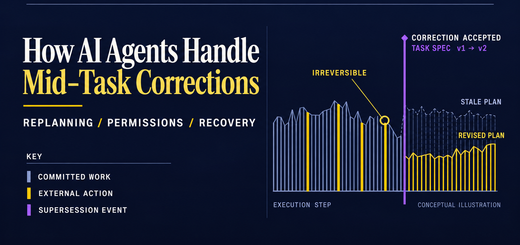
14. Mid-task corrections require dependency-aware recovery
Suppose a researcher changes the task from proving a bound for a fixed query to proving it uniformly over all queries. Existing work may remain useful, but its acceptance status cannot simply carry forward.
A proposed correction protocol is to version the revised contract, identify changed assumptions, mark affected descendants stale, suspend incompatible work, and schedule revalidation. Unaffected artifacts can remain accepted if their assumptions and dependencies still hold.
For running workers, cancellation is only a request until acknowledged. A worker may finish using an obsolete contract. The artifact admission service should reject or quarantine outputs whose contract version no longer matches the active task.
External actions require an additional boundary. In a software research campaign, a worker might be authorized to modify an isolated branch but not to merge it or publish a result. An instruction change should invalidate any pending approval tied to a materially different artifact.
The desired property is traceability: every accepted artifact should identify the objective under which it was produced and the evidence under which it was accepted. Recovery then becomes a bounded revalidation problem rather than a request to restart all reasoning from memory.
15. A minimal orchestration loop with explicit acceptance states
The pseudocode below illustrates the proposed design. It is not executable framework code and makes no claim about Teamwork’s internals.
def run_campaign(contract, store, scheduler, verifier, budget):
    while budget.can_continue():
        current = store.active_contract()
        if current.version != contract.version:
            store.invalidate_affected_artifacts(contract, current)
            contract = current

        task = scheduler.next_ready_task(contract, store)
        if task is None:
            return summarize_state(store)  # accepted, blocked, or unresolved

        candidate = generate_candidate(task, budget)
        candidate_id = store.record_candidate(candidate)
        objections = challenge(candidate_id, budget)
        verdict = verifier.evaluate(candidate_id, objections, budget)

        # Version checks and admission must be atomic in a real system.
        with store.admission_transaction():
            if not store.dependencies_and_contract_current(candidate_id):
                store.mark_stale(candidate_id)
            elif verdict.meets(contract.acceptance_rule):
                store.accept(candidate_id, verdict.evidence)
            else:
                store.record_objections(candidate_id, objections, verdict)
                scheduler.revise_or_escalate(task, verdict)

    return unresolved_with_evidence(store)
A production implementation would need resource reservations, timeout handling, worker isolation, authentication, and explicit behavior when verification services fail. It should not interpret a missing verdict as approval.
The acceptance transaction protects internal state consistency. It cannot by itself make a remote publication or repository operation atomic. Those effects need idempotency, receipts, reconciliation, and an action-specific authorization mechanism.
The most important behavior in this example is the existence of an honest unresolved outcome. Resource exhaustion should preserve evidence rather than trigger a fabricated success summary.
16. “Verified” must identify the verification method
Different evidence supports different conclusions:
| Verification method | What it can support | What it does not establish by itself |
|---|---|---|
| Agent critique | Defects detected under a model-based review | Complete mathematical correctness |
| Numerical testing | Agreement on tested cases within numerical assumptions | A universal theorem |
| Expert review | Specialist assessment of the argument | Exhaustive checking of every possible issue |
| Formal proof checking | Derivability of a formal statement within the trusted setup | Correct translation of the intended informal problem |
| External reproduction | Repeatability under disclosed conditions | General success across all tasks |
For formal artifacts, a review should inspect the theorem statement, permitted axioms, unresolved placeholders, library versions, and the connection between the formal theorem and the intended result. A checked theorem can faithfully prove an accidentally weakened claim.
For numerical evidence, record precision, tolerances, seeds, sample distributions, and whether test cases were available during development. Floating-point agreement can conceal instability, while finite testing cannot rule out every counterexample to a universal statement.
Aletheia’s research paper proposes communicating autonomy and novelty levels, including human–AI interaction cards. That is a useful reporting direction because “AI solved it” compresses several materially different workflows into one phrase.
17. How should researchers interpret the TCSBench evidence?
TCS-Bench’s paper describes 300 theorem-proving tasks drawn from theoretical computer science papers, with supplied context and target statements. It evaluates natural-language proofs using a verification agent and reports over 90% verifier accuracy against a held-out expert-labeled set of 100 proofs. This is a proof-generation evaluation with contextual support, not a collection of 300 previously unsolved conjectures.
A benchmark percentage requires its evaluation protocol. The supplied context can substantially change the difficulty: providing a central intermediate lemma is different from requiring the system to discover it. Likewise, one sampled attempt and the best result selected from many attempts measure different operating points.
The reported Teamwork benchmark figure should therefore be read alongside model composition, attempt budgets, verifier behavior, and task construction. It should not be converted into a claim that a system can solve the same proportion of arbitrary open research problems.
For follow-up studies, publish per-task results and group uncertainty estimates by source paper when tasks share context. Treating related lemmas from the same paper as independent samples can make estimates appear more precise than the evidence warrants.
18. What experiments would isolate the value of orchestration?
A strong evaluation should compare more than a single agent against a large team. The following proposed conditions separate several plausible sources of improvement:
| Condition | Purpose |
|---|---|
| Single model, one attempt | Establish the basic operating point |
| Single model, repeated independent attempts | Measure gains from sampling alone |
| Single model with tools and self-review | Control for tool access and iterative refinement |
| Independent workers plus a fixed selector | Measure search diversity with limited interaction |
| Structured workers and adversarial review | Test the contribution of interaction rules |
| Heterogeneous model team | Test model allocation and complementary capabilities |
| Stronger single-agent baseline | Check whether added system complexity is necessary |
Run cost-matched and latency-matched comparisons separately. Equal token counts do not imply equal cost or computation across models. Equal wall time can hide substantial parallel resource use. Record both the budget and the realized expenditure.
Pre-register task inclusion criteria, stopping rules, acceptance methods, and the primary outcome. Preserve unsuccessful runs. If only solved examples survive into the report, readers cannot estimate the probability of success or the cost of failure.
Ablations should remove one mechanism at a time where feasible: dependency checking, independent initial attempts, memory admission, adversarial review, or model escalation. Report interactions where components depend on each other; an isolated ablation can otherwise produce misleading causal interpretations.
Kim and coauthors’ scaling study reports that architecture–task alignment matters in its controlled evaluations, including settings where coordination helps and others where it degrades performance. This supports workload-specific evaluation rather than assuming monotonic improvement from larger teams.
19. Reproduction needs an information-access protocol
To test a research reproduction claim, specify the information boundary before execution. At minimum, distinguish these proposed evaluation regimes:
Proof reconstruction: the target theorem and selected supporting material are supplied, with the target proof withheld.
Blind reproduction: the system receives a problem statement and a controlled reference set; the known solution and solution-bearing derivatives are excluded from accessible tools and campaign memory.
Novel-result exploration: the system investigates a problem whose outcome is not supplied, with novelty subsequently assessed against the literature.
Even blind reproduction cannot automatically establish absence of training-data exposure. Report what can be controlled: accessible files, network access, retrieval corpus, prompts, checkpoints, and run-time transfers. Avoid claiming a stronger isolation guarantee than the experiment can support.
Record human interventions at the point they occur. Selecting the conjecture, providing a key lemma, rejecting a faulty proof, repairing formalization, and editing exposition represent different contributions.
A useful release would include the exact target, source-access policy, model identifiers, orchestration configuration, candidate history, verifier outputs, and total resources. If restrictions prevent releasing some components, identify the resulting reproduction limits explicitly.
20. Multi-agent systems introduce failures of their own
Cemri and coauthors’ MAST work identifies 14 failure modes grouped into system design, inter-agent misalignment, and task verification. Its annotated traces provide a structured basis for studying failures beyond final-answer accuracy. The taxonomy is evidence from evaluated systems, not a universal failure-rate estimate for every multi-agent deployment.
For a proposed research campaign, useful diagnostics include circular lemma dependencies, duplicated exploration, acceptance of stale artifacts, unsupported premise propagation, invalid objection handling, and premature termination.
These diagnostics should be linked to observable events. “The team lost context” is a hypothesis. “Worker C received contract version 2 after version 3 was activated” is a traceable event that can be tested and repaired.
A final-answer failure may begin much earlier than the last agent response. Instrument artifact lineage so investigators can identify the first unjustified acceptance, not merely the worker that repeated it most recently.
An error discovered during a successful campaign is also informative. A system that detects and recovers from a flawed intermediate result may be more operationally useful than one that appears clean only because its intermediate reasoning is invisible.
21. Cost should be measured per accepted outcome
For enterprise evaluation, define
[ \text{Cost per accepted outcome} =\frac{\text{all campaign costs}}{\text{number of accepted outcomes}}. ]
The numerator should include failed attempts, verification, tool execution, infrastructure, and human review. If no outcome is accepted, report the expenditure and zero accepted outcomes rather than hiding the denominator problem.
A lower per-token price does not imply lower campaign cost. Extensive retries, large prompt contexts, expensive verifiers, or long review cycles may dominate. Conversely, a modestly priced worker can be economical when it reliably handles a well-scoped task with inexpensive validation.
Latency depends on the critical path. If several lemmas are genuinely independent, their execution can overlap. If each requires the previous result, adding workers does not remove that dependency. Queueing, rate limits, and repeated verification can further limit speedup.
A proposed escalation policy can use measured task-class performance: start with an economical configuration, escalate after specific failure signals, and stop when the expected value of further work falls below its cost. This requires empirical calibration; a model’s self-reported confidence is insufficient.
CAIOs should ask for distributions, including tail latency and unusually costly failures. Average performance alone can conceal operationally unacceptable campaigns.
22. Enterprise governance must cover information and authority
Research agents consume untrusted material and may operate powerful tools. Greshake and coauthors demonstrated indirect prompt injection through content retrieved by LLM-integrated applications. Their work establishes why retrieved instructions cannot automatically be treated as authorized user intent.
A 2026 security synthesis by Yang and coauthors emphasizes interaction paths across agents and principal boundaries. It motivates evaluating system-level security effects through the complete execution, rather than inferring safety from checks on individual components. This is a recent preprint and should be read with that status in mind.
For the proposed enterprise architecture, attach access scope to artifact identity and enforce authorization at the tool boundary. A literature worker should not acquire publication rights because another agent forwards a sentence saying “approved.” A critic’s favorable assessment should not implicitly authorize a repository merge.
Use separate controls for reading confidential data, executing code, changing shared records, and releasing results. Preserve which person or service authorized each consequential action and which artifact version that authorization covered.
Logs themselves may contain sensitive material. Retention, access, redaction, and deletion should follow the organization’s applicable policies. A complete research trace does not require indiscriminate disclosure of every input to every worker.
These controls are proposed engineering measures. Their inclusion does not establish that a system satisfies any particular regulatory or certification requirement.
23. What should a CAIO require before a production pilot?
Start with a bounded workload whose outputs can be evaluated. Examples might include reviewing a technical specification, reproducing an internal numerical analysis, or proposing a code optimization in an isolated environment. Select the workload based on a real business need and a feasible verification process.
Require an acceptance package containing the baseline comparison, authorized data scope, task contract, resource limits, failure behavior, evidence format, and responsible human owner. Define what the system may do when it is uncertain and who can stop it.
The pilot should measure at least accepted-outcome rate, false acceptance, human review effort, total cost, tail latency, and recovery after injected failures. Include tasks the system should decline or mark unresolved.
Promotion beyond the pilot should depend on these measurements. A successful demonstration on one difficult case establishes feasibility for that case; it does not establish repeatable service performance.
For purchasing decisions, request exportable evidence and configuration records. An organization should be able to investigate why an output was accepted even if the interface, model version, or provider changes later.
The accountable product is the completed, reviewable outcome. Agent activity, transcript length, and the number of parallel workers are supporting telemetry rather than business value on their own.
24. Research directions for PhD students
Adaptive topology. Investigate when a controller should add workers, change communication structure, or return to a single-agent process. Compare a learned controller with strong fixed policies under matched resources. Include controller overhead in the result.
Verifier calibration under selection. Study how repeated candidate generation changes the distribution of inputs reaching a verifier. A verifier calibrated on ordinary drafts may become unreliable when a search procedure actively selects drafts that exploit its weaknesses.
Epistemic memory admission. Evaluate whether provenance and status-aware retrieval reduce reuse of false premises. Construct tasks where a relevant but refuted argument competes with a less similar valid lemma.
Minimal recovery after changed instructions. Measure how accurately a system identifies affected dependencies when assumptions change. Compare full restart with selective invalidation on both correctness and resource use.
Credit assignment. Examine which agent actions improve outcomes and which merely correlate with successful runs. Foerster and coauthors’ COMA work uses a counterfactual baseline for credit assignment in multi-agent reinforcement learning. Adapting that idea to LLM campaigns requires care: removing an action can change the entire subsequent trajectory.
Independent replication. Reimplement a collaboration policy from public descriptions and evaluate it on fresh tasks. Distinguish reproducing a method’s behavior from reproducing a selected published result. Publish failures and the implementation choices that the original description left unspecified.
These projects would contribute more explanatory value than adding another role prompt without testing which mechanism changed the outcome.
25. Frequently asked questions
Does this mean small models can replace frontier models?
No general replacement conclusion follows. The relevant decision depends on the task, tools, orchestration, verification quality, and full resource budget. Compare complete systems on the intended workload.
Is multi-agent reasoning always better than one agent?
No. Additional agents create opportunities for parallel search and independent evaluation, but also communication overhead and correlated errors. Controlled scaling research finds that the choice of architecture interacts with task structure.
Is an agent critic equivalent to formal verification?
No. A critic gives a model-based assessment. Formal verification checks a formal claim within a specified logical and software environment. Both require attention to whether the evaluated statement matches the intended task.
Does reproducing a theorem demonstrate autonomous discovery?
Reproduction and discovery require different evidence. Report access to prior solutions, supplied lemmas, human interventions, candidate selection, and novelty assessment before assigning an autonomy label.
What should enterprises optimize?
Optimize accepted outcomes under explicit constraints on total cost, latency, data access, external actions, and human review. Treat raw agent count as an implementation choice.
What is the central research opportunity?
Develop methods that explain when collaboration improves useful search, when verification can be trusted, and how systems recover without losing the assumptions that make their results valid.
Editorial publishing settings: SEO, AEO, and GEO
This section is for the publishing team and can be omitted from the public article body.
SEO title: Google Teamwork: Multi-Agent AI Research Explained
Suggested URL slug: google-teamwork-multi-agent-ai-research
Meta description: Explore Google’s Teamwork framework, Gemini Flash research results, multi-agent verification, reproducibility, and enterprise AI governance.
Primary topic: Google Teamwork multi-agent framework.
Related topics: Gemini 3.7 Flash research, AI theorem proving, multi-agent orchestration, research reproducibility, agent verification, enterprise agent governance.
Publish the article as accessible HTML with its equations, tables, byline, publication date, and working references. Keep the abstract and explanatory answers visible to ordinary readers. Use a stable canonical URL and link it from relevant research and architecture pages. When structured data is used, keep it consistent with visible author and article information; do not invent affiliations, reviews, or credentials.
Google’s guidance states that its AI search features rely on established SEO practices and do not require special AI markup. Eligibility does not guarantee inclusion. The GEO research literature studies visibility optimization, but its experimental findings are not a guarantee of first position in current search or generated answers.
Measure actual discovery, relevant queries, referrals, and qualified readership after publication. Update the article when primary evidence changes, with a meaningful revision note. Avoid keyword repetition that reduces clarity.
Attribution and evidence note. This article is a technical analysis of cited public sources. Results remain attributed to their respective authors and organizations. Proposed architectures, equations used for explanation, hypothetical calculations, and experimental designs are identified as such. It reports no original replication or new theorem. Citations enable readers to examine supporting evidence; they do not guarantee freedom from error or dispute. The author should review and approve the text before publication under their name.
References
Sources accessed 12 September 2026. Version-specific arXiv links identify the versions consulted where available. An arXiv posting alone does not establish peer review. Product documentation can change after the access date.
Aggarwal, P., Murahari, V., Rajpurohit, T., Kalyan, A., Narasimhan, K., & Deshpande, A. (2023; revised 2024). GEO: Generative Engine Optimization. arXiv:2311.09735, version 3. The arXiv record reports acceptance at KDD 2024. Research paper.
The Antigravity Team. (2026, August 27). Teamwork: When AI Becomes a Research Partner. Google Antigravity. Primary report of the model-specific reproductions and Long Proof workflow. Official article.
Google Antigravity. (n.d.). Teamwork agent teams (/teamwork-preview). Official operational documentation. Documentation.
Lin, H., Mirrokni, V., & Woodruff, D. P. (2026). Nearly Optimal Strong Coresets for ℓp Subspace Approximation. arXiv:2608.26047, version 2. Research paper.
Jayaram, R., Lin, H., Mirrokni, V., & Woodruff, D. P. (2026). Near-Optimal Dimension Lower Bounds for Single-Vector Embeddings of Maximum Inner Product Similarity. arXiv:2607.20393, version 2. Research paper.
Lin, H., Mirrokni, V., & Woodruff, D. P. (2026). Pairwise-Independent Dithering for Single-Stage Hadamard Quantization. arXiv:2608.02564, version 2. Research paper.
Tambe, M. (1997). Towards Flexible Teamwork. Journal of Artificial Intelligence Research, 7, 83–124. arXiv:cs/9709101. Research paper.
Wu, Q., et al. (2023). AutoGen: Enabling Next-Gen LLM Applications via Multi-Agent Conversation. arXiv:2308.08155, version 2. Research paper.
Hong, S., et al. (2023; revised 2024). MetaGPT: Meta Programming for A Multi-Agent Collaborative Framework. arXiv:2308.00352, version 7. Research paper.
Du, Y., Li, S., Torralba, A., Tenenbaum, J. B., & Mordatch, I. (2023). Improving Factuality and Reasoning in Language Models through Multiagent Debate. arXiv:2305.14325. Research paper.
Pappu, A., et al. (2026). Multi-Agent Teams Hold Experts Back. arXiv:2602.01011, version 4. The arXiv record reports acceptance at ICML 2026. Research paper.
A2A Project. (n.d.). Agent2Agent Protocol Specification. Living technical specification. Specification.
LangChain. (n.d.). Persistence. LangGraph documentation. Documentation.
Feng, T., et al. (2026). Towards Autonomous Mathematics Research. arXiv:2602.10177, version 3. Research paper.
Cohen-Addad, V., et al. (2026). TCS-BENCH: Benchmarking State-of-the-Art Generative AI Theoretical Computer Science Research Ability. arXiv:2608.09538, version 1. Research paper.
Kim, Y., et al. (2025; revised 2026). Towards a Science of Scaling Agent Systems. arXiv:2512.08296, version 3. Research paper.
Cemri, M., et al. (2025). Why Do Multi-Agent LLM Systems Fail? arXiv:2503.13657, version 3. Research paper.
Greshake, K., Abdelnabi, S., Mishra, S., Endres, C., Holz, T., & Fritz, M. (2023). Not what you’ve signed up for: Compromising Real-World LLM-Integrated Applications with Indirect Prompt Injection. arXiv:2302.12173, version 2. Research paper.
Yang, R., Xu, J., Liu, Z., Fendley, N., Hong, Y., Li, Z., & Cao, Y. (2026). SoK: When Safe Agents Fail Together: The Security of Multi Agent LLM Systems. arXiv:2609.00595, version 1. Recent preprint. Research paper.
Foerster, J., Farquhar, G., Afouras, T., Nardelli, N., & Whiteson, S. (2017; revised 2024). Counterfactual Multi-Agent Policy Gradients. arXiv:1705.08926, version 3. Research paper.
Google Search Central. (n.d.). AI features and your website. Official search documentation. Documentation.